Myths of American Slavery by Walter Kennedy
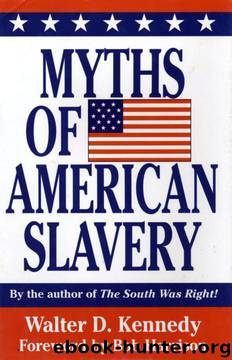
Author:Walter Kennedy [Kennedy, Walter]
Language: eng
Format: epub
Published: 2011-07-06T21:02:00+00:00
MYTH: Southerners who support the notion of a benevolent slaveholding society are merely defending slavery.
REALITY: There is more to the idea of a benevolent slaveholding society in the Old South than the so-called moonlight and notion of slavery "down South." The retort that by defending the truth about the institution of slavery, one is not defending the institution of slavery is not a twenty-first-century sentiment. As pointed out in Chapter 3, in 1845 Dr. N. L. Rice made the same plea to the people of Ohio when he was defending the view that slavery in itself was not a sin. Dr. Rice was a vocal opponent of slavery, yet, he defended the truth about the institution of slavery while working for its elimination. General Robert E. Lee was so much opposed to slavery that he freed his slaves long before the War for Southern Independence, yet, he fought for his state and the South during the War. President Jefferson Davis believed that slavery would have a natural end and that the slaves had to be educated to make them "fit for freedom and unfit for slavery." Southern historian Francis B. Simkins noted that both good and bad relations existed between slaves and masters in the Old South. If a person is seeking the truth about the institution of slavery in America, why should he ignore the good and only report the negative? Defending the truth about the institution of slavery is not tantamount to defending slavery itself. Unfortunately, with the adoption of the politically correct view about slavery (i.e., the Radical Abolitionists' view), only the negative view is reported, and anyone who strays from the "party" line about slavery is viewed as a "defender of slavery."
MYTH: The North provided a haven of freedom and of opportunity for African-Americans.
REALITY: The myth of the North as a land of freedom and opportunity for African-Americans runs opposed to every known fact about race relations in the North at that time. This myth is based upon the modern assumption that slavery was abandoned in the North because it offended Northerners' humanitarian views. Yet, as John Adams pointed out, slavery was eliminated because Northern white workers did not wish to compete with slave labor. It was for the benefit of white workers and not African-Americans that slavery was eliminated in the North. Also, as proven, Northern states spared no effort in preventing an increase in the numbers of free African-American citizens in the North. This fear of increasing numbers of African-Americans in their states became even greater after Abraham Lincoln's Emancipation Proclamation. In a message to Congress in 1862 Lincoln took note of this fear: "But why should emancipation South send free people North? And in any event cannot the North decide for itself whether to receive them?"1°2 These are just a few examples which prove how inhospitable the people of the North were to their fellow Northerners, Southerners, and even Europeans all noted that even though the North had abandoned slavery, it still clung to the notion of Negro inferiority.
Download
This site does not store any files on its server. We only index and link to content provided by other sites. Please contact the content providers to delete copyright contents if any and email us, we'll remove relevant links or contents immediately.
| General | Discrimination & Racism |
Nudge - Improving Decisions about Health, Wealth, and Happiness by Thaler Sunstein(7706)
The Fire Next Time by James Baldwin(5444)
iGen by Jean M. Twenge(5415)
Adulting by Kelly Williams Brown(4574)
The Sports Rules Book by Human Kinetics(4386)
The Hacking of the American Mind by Robert H. Lustig(4383)
The Ethical Slut by Janet W. Hardy(4251)
Captivate by Vanessa Van Edwards(3839)
Mummy Knew by Lisa James(3691)
In a Sunburned Country by Bill Bryson(3542)
The Worm at the Core by Sheldon Solomon(3487)
Ants Among Elephants by Sujatha Gidla(3467)
The 48 laws of power by Robert Greene & Joost Elffers(3291)
Suicide: A Study in Sociology by Emile Durkheim(3022)
The Slow Fix: Solve Problems, Work Smarter, and Live Better In a World Addicted to Speed by Carl Honore(3009)
The Tipping Point by Malcolm Gladwell(2921)
Humans of New York by Brandon Stanton(2873)
Get What's Yours for Medicare: Maximize Your Coverage, Minimize Your Costs by Philip Moeller(2730)
Handbook of Forensic Sociology and Psychology by Stephen J. Morewitz & Mark L. Goldstein(2705)
